Roy Harpaz
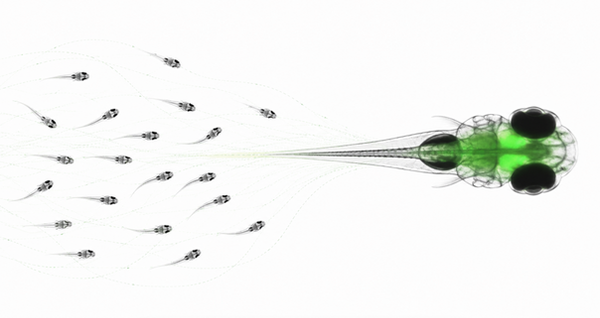
I study how animals use social information to guide moment-to-moment decisions and how these individual decisions give rise to collective behavior. I believe that neural mechanisms are best understood in the context of the natural behaviors they evolved to support.
Working at the intersection of neuroscience and ethology, I combine quantitative behavioral experiments, computational modeling, and neurobiological approaches to identify the behavioral algorithms animals use and the circuits that implement them.
My primary model organism is the zebrafish, whose behavioral repertoire spans split-second movement decisions within a shoal, flexible foraging strategies, and learning. The genetic accessibility of zebrafish, together with advanced imaging techniques, makes it possible to connect these behaviors to the activity of identified neurons and neural circuits.


Natural collective behavior of zebrafish larvae
Individual larva interacting with virtual agents


Whole-brain and targeted neural imaging at single-cell resolution during naturalistic social behavior.
2-photon calcium imaging in a socially interacting larval zebrafish
Zoom in view on neural activity in the zebrafish habenula
To complement experiments in fish, I use artificial neural-network agents trained through multi-agent reinforcement learning. Comparing the behavioral algorithms and internal representations that emerge in these visually guided agents with those identified in zebrafish provides a controlled way to identify candidate mechanisms and generate predictions for animal experiments.

Focal fish visual field
A group of 5 MARL trained agents

A group of adult medaka fish

A female Amazon molly swimming with her offspring, all clones of their mother.
My research also takes a comparative approach. I study medaka to examine distinct forms of social behavior and Amazon mollies, whose clonal reproduction provides a powerful system for disentangling genetic and environmental influences on behavior. I also compare artificial and biological neural networks, using artificial networks as computational models to investigate the representations and algorithms that generate complex behavior